
Rebalancing Feels Like Doing Nothing. Over 20 Years, It Will Add 60% to Your Returns.
Why rebalancing your portfolio might be a good option.

I honestly think you might have heard the phrase ‘‘buy low, sell high " at least once a day.
It sounds very, very simple. So simple that quitting your full-time job tomorrow and just doing exactly that, buying low and selling high, and continuing doing this forever.
However, it’s not quite that simple.
It’s all emotional.
Watching something you own, put your hard-earned (hopefully legal) capital into, and it keeps going up, and choosing to sell a piece or close the whole position. I wouldn’t blame you if you might not have the stomach for it.
I for sure didn’t for an extended period of time.
Then you have something you own. It goes against you, and you buy more of said business. Again, this goes against every human emotional principle. We’re all risk-averse.
Nobody, I repeat, nobody does this ‘‘naturally’’.
You will need something outside your own willpower to force the decision, on a schedule, whether you feel like it or not.
The Boring Answer That Almost Undersells the Whole Point
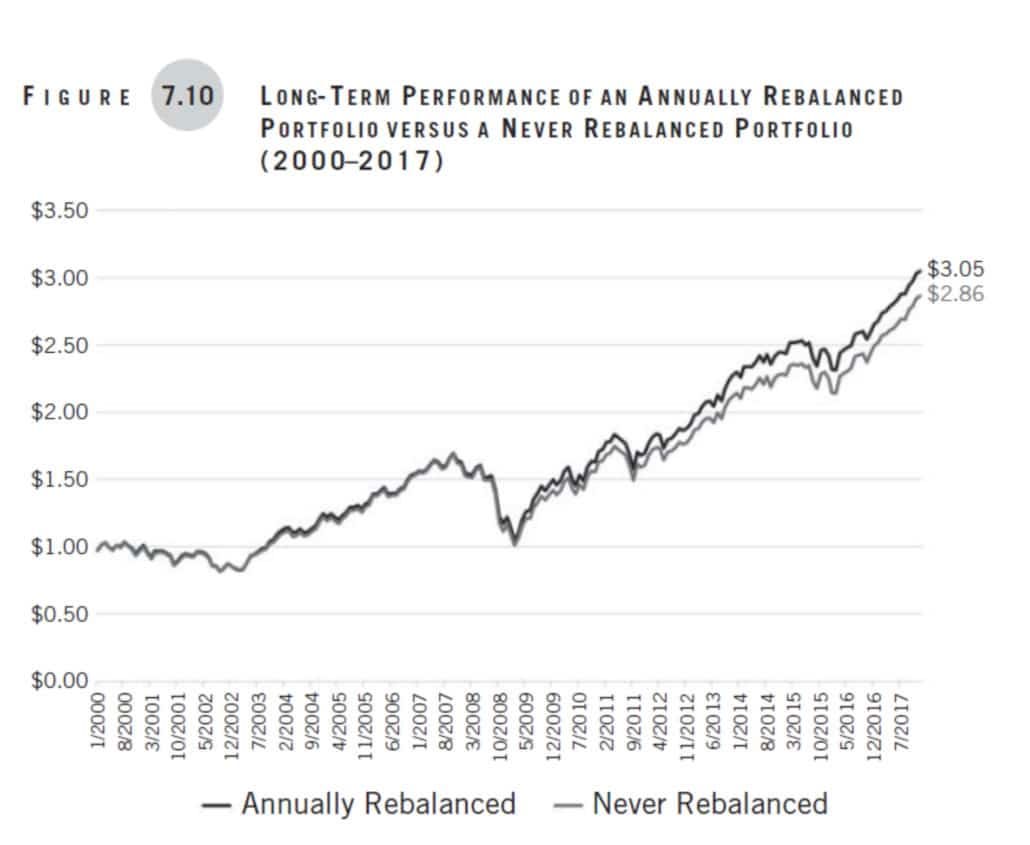
The above picture depicts something interesting.
It’s running a portfolio that’s rebalanced against one that isn't. At the end of the road, the returns are surprisingly close.
Almost close enough that you would be forgiven for wondering if the whole discipline is a waste of effort. It’s only a few percentage points apart, in total, after a 20-year span spanning multiple crashes and booms.
It’s not nothing, but not the dramatic gap you would expect from something people treat as gospel, right?
Funny enough, here’s the part that completely gets buried because of this.
The total-return comparison test is wrong. Not by a bit, but entirely wrong.
Why This Only Gets Interesting Once You Start Withdrawing
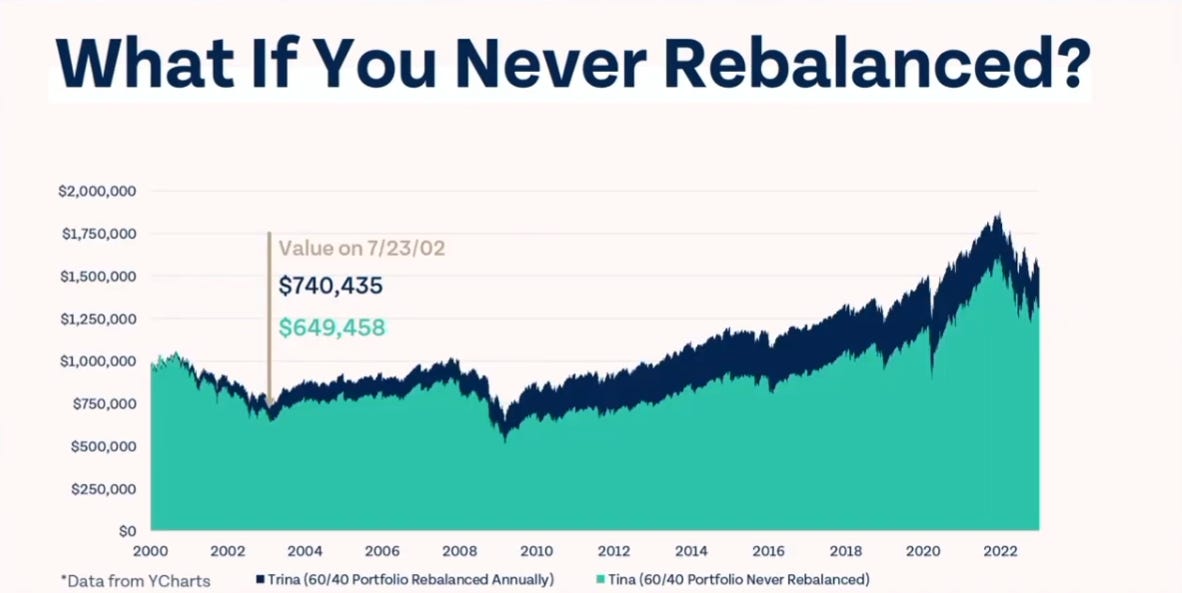
Honestly, nobody accumulating money for 30 years really feels any difference between a rebalanced portfolio and a 'didn’t touch’ portfolio.
Picture this.
Two people with the same starting balance and the same 60/40 split between stocks and bonds. Both of them have the same withdrawal rate and the exact same retirement date (highly unlikely, but use your imagination for a minute). Person A rebalanced back to target every year without fail. Person B, however, just sits and does… nothing.
It lets the market take him wherever the market wants.
Now, picture a market crash hitting two years into retirement. Both Person A and B take a hit, obviously.
But here’s where the path actually splits.
The never rebalanced portfolio has already drifted.
Usually toward more stock exposure since stocks tend to run further before any crash than bonds do. That’s basic market dynamics. This simply means that more of the portfolio was sitting in that one thing that just got hit the hardest.Withdrawals now have to come from a already depleted pile.
This locks in losses at the worst possible moment. Right when your account can least afford it.The rebalanced portfolio has more flexibility.
Money can simply be pulled from whatever side held up the best. This allows for the beatendown side to sit, relax, and recover rather than being sold into the bottom.
Now, play this exact dynamic out across twenty some years, some more crashes, some beautiful recoveries, and this gap doesn’t stay small.
Everything compounds, so, that gap we’re talking about compounds as well!
A difference, as previously shown, that looked like a rounding error after years can turn into a genuinely life-changing sum by the time retirement is over- painful reality. Not because rebalancing predicts the market, not at all.
It's simply because it removes the one decision retirees are worst positioned to make well under stress…
Which pile of money to sell from when everything already feels terrifying?
The Real Mechanism Isn’t Timing. It’s Removing the Decision Entirely.
Honestly, this isn’t a story about being a smartass and buying low and selling high on purpose.
It’s a system that automatically buys low and sells high on a fixed schedule. Specifically so nobody has to trust their own emotions in the moment it matters most!
Honestly, that’s the whole trick.
A rule that fires whether you feel brave or terrified that particular year removes the exact moment where most investors sabotage themselved. You do not need to correctly guess the bottom or top. You simply need a rule that doesn’t care, in the slightest, how you feel about the bottom.
Here’s Your Takeaway From This All…
The total return numbers alone make rebalancing look almost optional.
Looking through a lense of someone actually living off the money, it actually stops looking optional entirely.
If you’re still accumulating rebalancing will most likely buy you a way smoother ride but not necessarily a significantly bigger number at the end.
If you’re withdrawing money to live on rebalancing is protecting you against the single worst sequence of events retirement can throw at you… A crash early on that is followed by years of forced selling from whatever’s already down.
Either way, the discipline has to be systematic. This means you need a fixed schedule and not a feeling. Simple because the feeling is precisely the thing that fails you at the worst possible moment…
Disclaimer
By having read this content, you acknowledge and accept the terms of the disclaimer that you can read here.
Before you go.
The investors who compound quietly over decades share one trait.
They protect their edge fiercely.
But they also know when to pass something valuable to someone who’ll use it.
If you know one person who takes investing seriously, forward this to them.
They get free access to everything you’re reading.
You earn points toward Premium every time someone subscribes through your link.
5 referrals unlocks one free month. 15 unlocks three. 30 unlocks six.
Someone is already climbing the leaderboard.
The question is whether you’re ahead of them or not.
→ Check where you stand on the leaderboard here
See you next time!
And remember, great investments don’t shout. They compound quietly.
—Yorrin
Note: I would love to hear from you!
If you want to share your thoughts or suggestions about FluentInQuality, or if there are any specific topics you’d like me to cover, just send an email to fluentinquality@gmail.com
Any other questions? Shoot me an email.
Don’t worry! I’ll never share your information.