


Peter Lynch ran the Fidelity Magellan Fund from May 1977 to May 1990.
13 years, 29.2% a year. He beat the S&P 500 in 11 of those 13 years, in a period when the index itself was doing about 15%, which is to say he doubled a market that was already having a very good time. $10.000 handed to him at the start came back as roughly $280,000. The fund went from about $18 million to $14 billion, which made it the largest mutual fund on earth.
Then he quit. He was 46.
Now here’s the number nobody puts in the thread. At its peak, that fund held around 1,400 stocks.
Yes, 1.4000. The man whose entire public reputation is “keep it simple, buy what you understand” was running a portfolio that no human being could hold in their head, let alone their brokerage account. Which should tell you that the version of Lynch you’ve absorbed from Twitter is missing something fairly important.
The most misquoted sentence in investing
You know the line. Invest in what you know.
People hear that as permission. You like the coffee, buy the coffee company. Your kids won’t shut up about a game, buy the game company. The shop is always busy, the shop must be a good stock. It’s a lovely idea because it’s flattering. It says your ordinary life has already done the hard part for you.
Lynch spent years telling people that’s not what he meant, and he never fully won the argument.
What he actually meant is closer to this. You will notice things before Wall Street does, because you stand in queues that analysts don’t stand in and you use products that analysts have never touched. That noticing is a lead. It’s the moment you decide to open the filings, not the moment you decide to buy.
Lynch found Dunkin’ Donuts as a customer. He didn’t buy it as a customer. He bought it after he understood the unit economics, the store expansion runway, and what it would earn if it kept opening locations at the pace it was opening them. His wife spotted L’eggs in a supermarket. That got the company onto his desk. What got it into the portfolio was the arithmetic.
The queue tells you something is happening. It tells you nothing about the price.
So the honest reframing of his famous advice is: your edge is in finding, not in judging. You get to see the story early. You still have to do the boring part, and there is no version of this where the boring part is optional.
A 10-bagger is a result, not a target
This is where most people go wrong before they’ve even started, and it’s a subtle one.
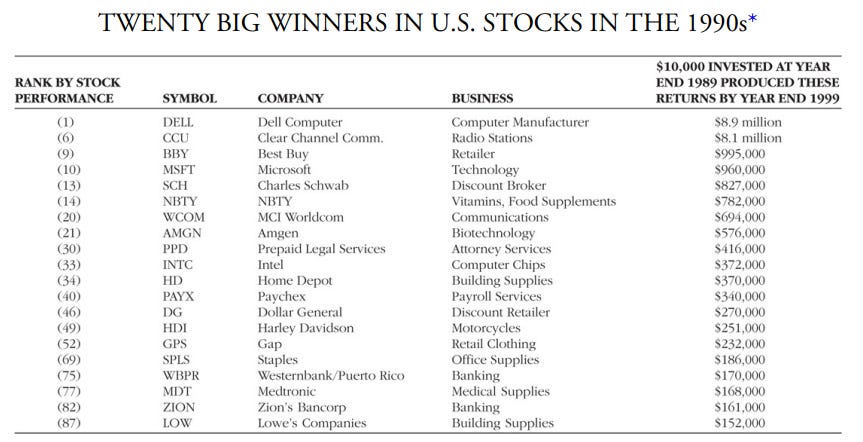
Nobody sits down and finds a tenbagger. What actually happens is you buy a small, good, unglamorous business at a sensible price, and then five or eight years later somebody points out that it’s up 900% and you say, huh, so it is.
The tenbagger is what the position becomes when you leave it alone. Hunting for one directly pushes you toward exactly the wrong stocks, because “what could go up 10x” sounds a lot like “what is currently speculative and unprofitable and priced on a story.” Those go up 10x sometimes. They also go to zero, which the backtest of your imagination tends to skip.
And here’s the part that makes the whole thing tractable.
You don’t need many. If you hold twenty positions and nineteen of them go absolutely nowhere, and one of them does 10x, your portfolio is up roughly 50% overall. If two do it, you’ve nearly doubled while being wrong about ninety percent of your ideas. That’s the actual shape of Lynch’s record, and it’s why he could afford 1,400 positions and a fair number of genuine disasters.
Being wrong most of the time is baked in. The strategy survives it as long as you don’t cap the winners.
Put every idea in a bucket first
Lynch’s most useful habit is also his least quoted one, which is unfair because it’s the one that actually improves decisions.
Before he asked whether a company was good, he asked what kind of company it was. That single step tells you what to expect, what to check, and when to sell. Most people skip it and then get confused when their steady dividend payer doesn’t triple.
Six buckets, roughly:
Slow growers. Big, mature, growing about as fast as the economy. You own these for income. They are not going to surprise you and they are not supposed to.
Stalwarts. Large, reliable, compounding at something like 10 to 12% a year. These are your ballast. A 40% gain is a good outcome here, and taking it is fine.
Fast growers. Small companies expanding 20%+ a year with a long runway of places to expand into. This is where the tenbaggers live. It’s also where you lose the most money, because the market prices them for permanent success.
Cyclicals. Earnings rise and fall with something outside the company’s control. The classic trap: they look cheapest on earnings right before earnings collapse. The P/E lies to you in both directions here.
Turnarounds. Broken things that might get fixed. Highest variance, least correlation to the market, and the category most likely to end in a permanent loss.
Asset plays. Something valuable sitting on the balance sheet that the market hasn’t priced. Property, a stake in another business, cash, a licence.
The reason this matters is that it stops you applying the wrong test. Judging a cyclical by its P/E is how people buy steel at the top. Judging a fast grower by its dividend is how you rule out every interesting company on the exchange.
Get the bucket right and half your analysis is already done.
What actually produces the big ones
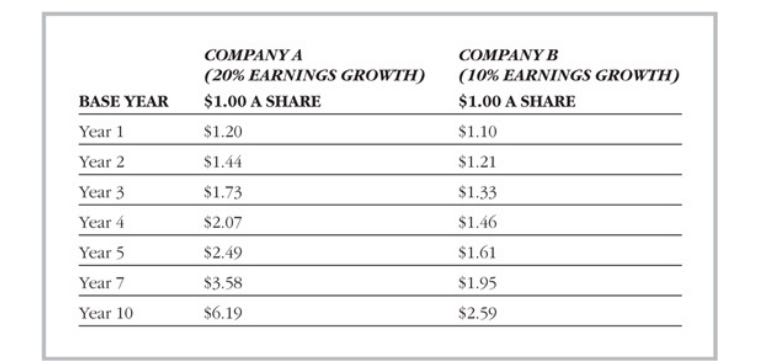
Once you’re in fast-grower territory, the pattern behind multibaggers is fairly consistent, and it’s less exciting than people want it to be.
A small base. A company doing €80 million in revenue can plausibly do €800 million. A company doing €80 billion cannot do €800 billion. This is arithmetic and it is undefeated. Most of the tenbaggers you’ll ever own will be businesses you were slightly embarrassed to mention.
A proven model being repeated. The best setup is a business that has already demonstrated the unit works, and is now simply doing it again in more places. Store 40 works, so build store 400. This is much safer than a business that still has to prove the concept, and it’s far easier to underwrite.
Room that’s actually there. Not “the market is worth €50 billion so if we get 2%.” Count the specific places it can go. Countries, cities, adjacent products, existing customers who could buy more.
Growth it can fund itself. If expansion requires constant new debt or new shares, your returns get diluted on the way up by the very growth you’re paying for. Check the cash flow statement before the income statement.
Something dull about it. Lynch had a real fondness for boring names, boring industries, and companies institutions were embarrassed to own. Dull keeps competitors away and keeps the price sane while the business compounds.
Nobody covering it. Low analyst coverage, low institutional ownership. This is the closest thing to a free variable in the whole exercise, and it’s why overlooked European small caps are such fertile ground. Half the continent’s best small businesses have two analysts and a website that looks like 2009.
The mistake that eats most of the return
Here’s the uncomfortable bit, and I’d put money on it applying to you personally.
The reason people don’t own tenbaggers is almost never that they failed to find one. It’s that they owned one for a while and then sold it at 2.4x because it had “had a good run” and the position had grown to an uncomfortable size and taking a profit felt responsible.
Lynch described this as pulling out the flowers and watering the weeds. You sell the thing that’s working because selling it feels like discipline, and you hold the thing that’s broken because selling it would mean admitting you were wrong.
A stock going up is not a reason to sell. It might be the single weakest reason available. The company is presumably up because the business is working, which is the thing you wanted when you bought it.
The actual reasons to sell:
The story you bought has changed. Growth stalled, the runway closed, a competitor arrived, management started doing something else.
The price now demands a future you no longer believe in.
You found something clearly better and you’re capital-constrained.
Notice that “it went up a lot” isn’t on the list. Neither is “I’m nervous.” Write your sell conditions down when you buy, because the version of you holding a position that has tripled is not a reliable narrator.
The honest scoreboard
Nobody should read this and expect a 29% decade, and I’d rather say so than let the headline do something dishonest on my behalf.
Lynch was not a man who occasionally checked in on some familiar brands. He visited hundreds of companies a year. He spoke to management constantly. He ran a portfolio of over a thousand names because he could not bear to pass on an idea, and he walked away at 46 because the job had consumed thirteen years of his life and he wanted to see his children. The “buy what you know” version of Lynch is a marketing artifact. The real one worked like a maniac.
There’s a survivorship problem too, and it’s worth naming. We remember Magellan because it won. Plenty of managers ran concentrated growth portfolios in the same period and are not on anyone’s reading list. Some of Lynch’s edge was process and some of it was operating a small, nimble fund in an era with a fraction of today’s competition and none of today’s data access.
What survives all of that is the framework, and the framework is genuinely good. Classify before you judge. Treat familiarity as a starting gun. Buy small, dull, self-funding businesses with somewhere obvious to grow. Then do the hardest thing in investing, which is nothing at all, for years, while the position gets uncomfortably large.
The finding is the easy part. Almost everyone gets that far.
The waiting is where the money is, and it’s the only part nobody can do for you.
See you next time!
And remember, great investments don’t shout. They compound quietly.
—Yorrin
Note: I would love to hear from you!
If you want to share your thoughts or suggestions about FluentInQuality, or if there are any specific topics you’d like me to cover, just send an email to fluentinquality@gmail.com
Any other questions? Shoot me an email.
Don’t worry! I’ll never share your information.
Disclaimer
By reading this content, you acknowledge and accept the terms of the disclaimer that you can read here.