
Alphabet Just Did Something That Has Never Happened Before. And Nobody Is Talking About It Correctly.
One of the most profitable companies in human history just said it doesn't have enough money. Here is why that sentence should change how you think about everything.
Stop what you are doing.
I need you to actually stop, because what I am about to explain to you is one of those things that sounds like a headline and gets scrolled past, but if you actually sit with it and let the numbers land, it will fundamentally shift how you see what is happening in the technology industry right now.
Alphabet just raised $80 billion by issuing new shares.
That is the headline. That is the thing people are arguing about on X. That is the thing the bears are pointing at and saying bubble. That is the thing that confused every analyst who covers the company and produced a thousand hot takes from people who read the first sentence and stopped there.
But here is what that sentence actually means when you understand the full picture.
The most profitable company on planet Earth just looked at its bank account, looked at its income statement, looked at its cash flows, and said: "We do not have enough’’.
Let that breathe for a moment.
First, Let Me Tell You What This Company Actually Is
Because I think a lot of people have lost the plot on Alphabet. They think of it as the Google search company. The YouTube company. The maps company. The thing that shows you ads when you search for shoes.
That framing is so outdated that it is almost embarrassing to hold.
Alphabet generated $174 billion in operating cash flow over the trailing twelve months. One hundred and seventy-four billion dollars. In cash. From operations. Not revenue. Cash. That is more than the GDP of most countries on earth. That is more money than Hungary, Morocco, Ecuador, and Slovakia combined produce in an entire year, from their entire economies, every farm, factory, service, tax, and transaction within their borders. Alphabet generates that in operating cash flow. In twelve months.
Q1 2026 alone: $109.9 billion in revenue. In three months. Google Search grew 19% and hit $60 billion in a single quarter. YouTube grew 11%. Google Cloud, which is the part of this story that is going to make your jaw drop, grew 63%.
On a $20 billion quarterly revenue base.
That is not a startup growing 63% off a $2 million base. That is a business that was already generating $80 billion a year in revenue, growing at 63%, which means by the arithmetic alone it is adding the equivalent of a new Fortune 500 company’s entire annual revenue every few months.
And the backlog. The contracted, signed, committed future revenue that enterprises have already agreed to pay. It nearly doubled in a single quarter to $462 billion.
In contracted future revenue.
That is more than the entire market capitalization of Exxon Mobil, one of the largest energy companies in the world, sitting in signed contracts waiting to be recognized as revenue.
This is what Alphabet is. This is the business we are talking about. And this business just said it does not have enough money.
So What Is Actually Going On
Here is the thing that the hot takes are missing. The question is not why Alphabet is raising money. The question is why the demand for what Alphabet sells is so violently large that even $174 billion in annual operating cash flow cannot keep up with it.
Because that is the actual story.
Google Cloud management said, explicitly and without hesitation, that Cloud revenue would have been higher if they had been able to meet demand. They are turning away enterprise customers. Not because the product is not good enough. Not because the sales team is not working hard enough. But there isn't enough physical infrastructure on Earth right now to serve every company that wants to give Google money.
Sit with that image for a second.
You walk into a store. You have cash in your hand. You want to buy something. The store tells you to leave because they are out of product and cannot restock fast enough. Now imagine that store is earning $174 billion a year in operating cash flow and still cannot restock fast enough.
That is what is happening at Google Cloud. That is why they need $80 billion.
The 2026 capital expenditure guidance is $180-$190 billion. The company generates approximately $174 billion in operating cash flow annually. The math tells you everything you need to know. They are being asked by the market, by actual signed contracts, by enterprises literally begging to give them money, to spend more capital than they generate in an entire year. And they are not even stopping there. Management said with complete composure that 2027 CapEx will significantly increase from 2026.
They have already raised $85 billion in debt over the past twelve months. They have already spent every dollar of discretionary cash flow. And now they are raising equity. Not because they are scared. Because the opportunity is so large and so urgent that they are willing to do absolutely anything to capture it.
That is not a company in trouble. That is a company in the middle of the single largest commercial opportunity it has ever encountered, running as fast as it physically can toward it.
The Backlog Is a Time Machine
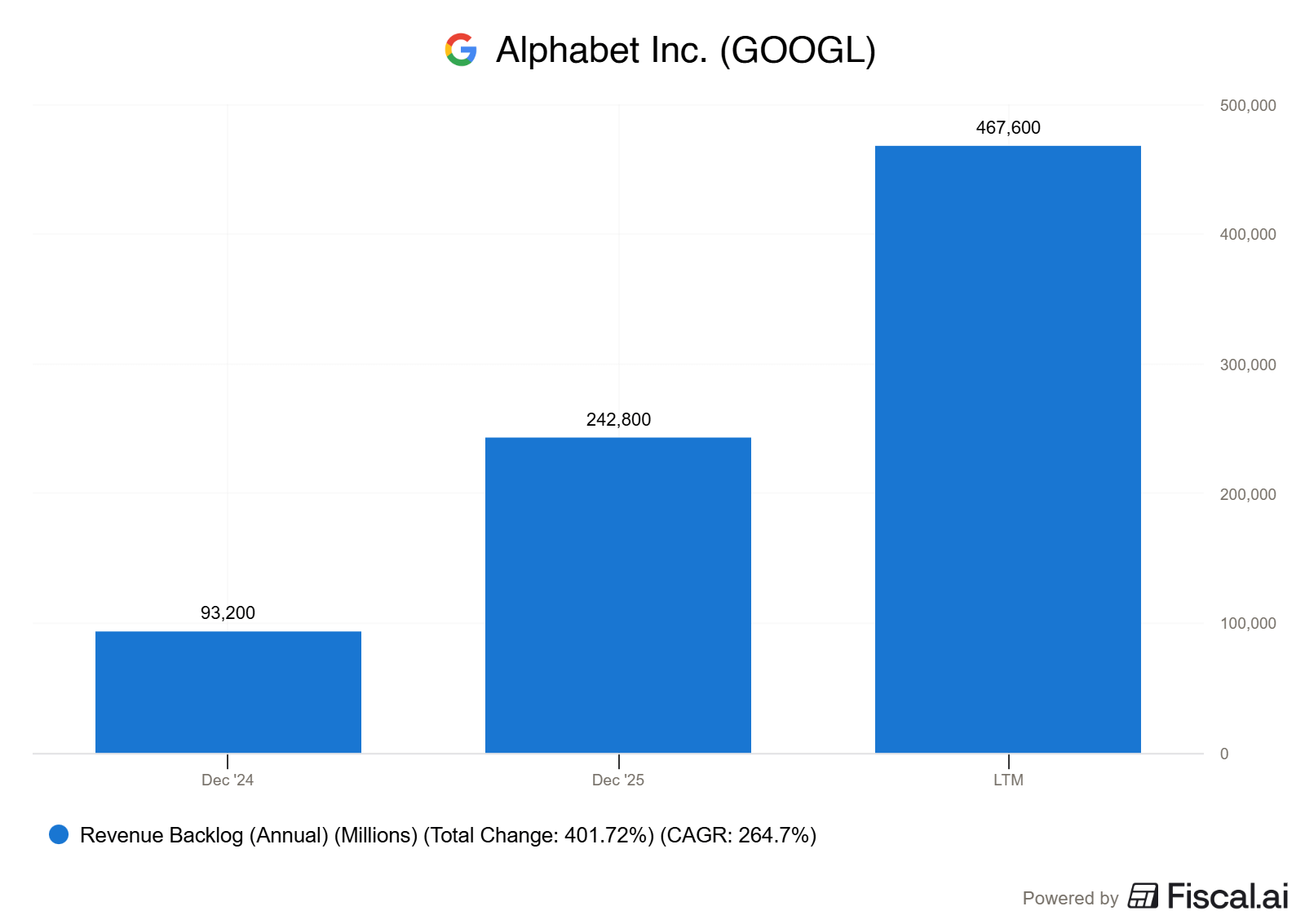
Let me explain something that I think most people do not fully appreciate about what a $462 billion backlog actually means.
When a company reports revenue, it tells you what happened. What it sold. What it earned. Revenue is history. It tells you where the business has been.
A backlog tells you where the business is going. A backlog is signed contracts. Committed spending. Enterprises that have already decided, already negotiated, already signed the paperwork, and are now simply waiting for Alphabet to build enough infrastructure to serve them. A backlog is the future, in writing, with names and amounts attached.
Google Cloud’s backlog nearly doubled in a single quarter. Not in a year. In three months. The business added approximately $230 billion in signed future contracts in ninety days.
More than half of that $462 billion, meaning north of $231 billion, is expected to be recognized as revenue in the next twenty-four months. The quarterly Cloud revenue run rate right now is $20 billion, which annualizes to roughly $80 billion. The backlog implies Cloud revenue will need to more than double over the next two years simply to work through the contracts already signed.
That is, before one single new customer signs a single new contract.
The backlog is a time machine showing you what Alphabet’s income statement will look like in 2027 and 2028. And what it shows you is a business that is going to be dramatically larger, at dramatically higher margins, than what you are looking at today.
The Full Stack Is the Moat That Nobody Can Buy
Here is where it gets genuinely interesting, because the reason Alphabet is winning this race is not money.
Every major technology company has money. It is not talent. Every major technology company has talent. The reason Alphabet is winning is architecture, and architecture takes a decade to build.
Alphabet is the only company on earth that owns the entire vertical stack of AI infrastructure from the bottom to the top. Start at the bottom: custom silicon. Alphabet designed its own TPU chips, the eighth generation of which just launched with three times the training performance of the prior generation and 80% better inference performance per dollar. These are not chips purchased from Nvidia or AMD. They are chips designed by Alphabet, fabricated to Alphabet’s specifications, tuned to run Alphabet’s models as efficiently as possible. The hardware and the software are designed by the same organization, which means the optimization happens at a level of depth that no company assembling a solution from multiple vendors can replicate.
One layer up: the models themselves. Gemini 3.1 Pro is processing more than 16 billion tokens per minute via direct API use, up from 10 billion last quarter. That growth rate, 60% in a single quarter at this scale, tells you that the model is not just good. It is being consumed at a rate that reflects genuine enterprise dependence. Not experimentation. Dependence.
One layer up: the platform. Gemini Enterprise is the system through which every employee of a Google Cloud enterprise customer can build agents. Paid monthly active users grew 40% quarter over quarter. Major global brands, including Bosch, Citi Wealth, Merck, and Mars, are inside this platform, building on it, depending on it, training their workflows around it. Every workflow built around Gemini Enterprise makes the switching cost higher and the relationship deeper.
One layer up: the applications. Search. YouTube. Maps. The Gemini app. All of these are simultaneously consumer products and data flywheels feeding signals back into the models and the advertising systems that power the revenue engine.
And wrapping the entire thing: security. AI is creating new attack vectors at a pace that is overwhelming the cybersecurity industry. Alphabet acquired Wiz in Q1 2026 for approximately $32 billion, and management described the performance as exceeding expectations. The combination of Wiz, Google’s threat intelligence, Gemini-powered security agents, and the existing Chronicle security operations platform gives Alphabet something no competitor has: an AI-native, full-stack cybersecurity offering sitting inside the same platform as the AI infrastructure it is protecting.
You cannot buy this architecture. You cannot replicate it in two years. You cannot build the TPUs without a decade of chip design experience. You cannot train the models without the TPUs. You cannot build the enterprise platform without the models. You cannot secure the enterprise platform without the security infrastructure. It is a vertical stack built layer by layer over fifteen years, and the companies that are now trying to compete with it are discovering that catching up requires not just matching Alphabet’s current state but matching the compounding effect of fifteen years of integrated development.
The Advertising Machine Is Accelerating, Not Dying
Let me dispose of the bear thesis once and for all, because it deserves a direct answer.
The bear on Alphabet says that AI will destroy Google Search. That people will ask ChatGPT instead of Googling. The advertising revenue engine will slow as queries migrate away. That the $60 billion quarterly Search revenue machine is a melting ice cube.
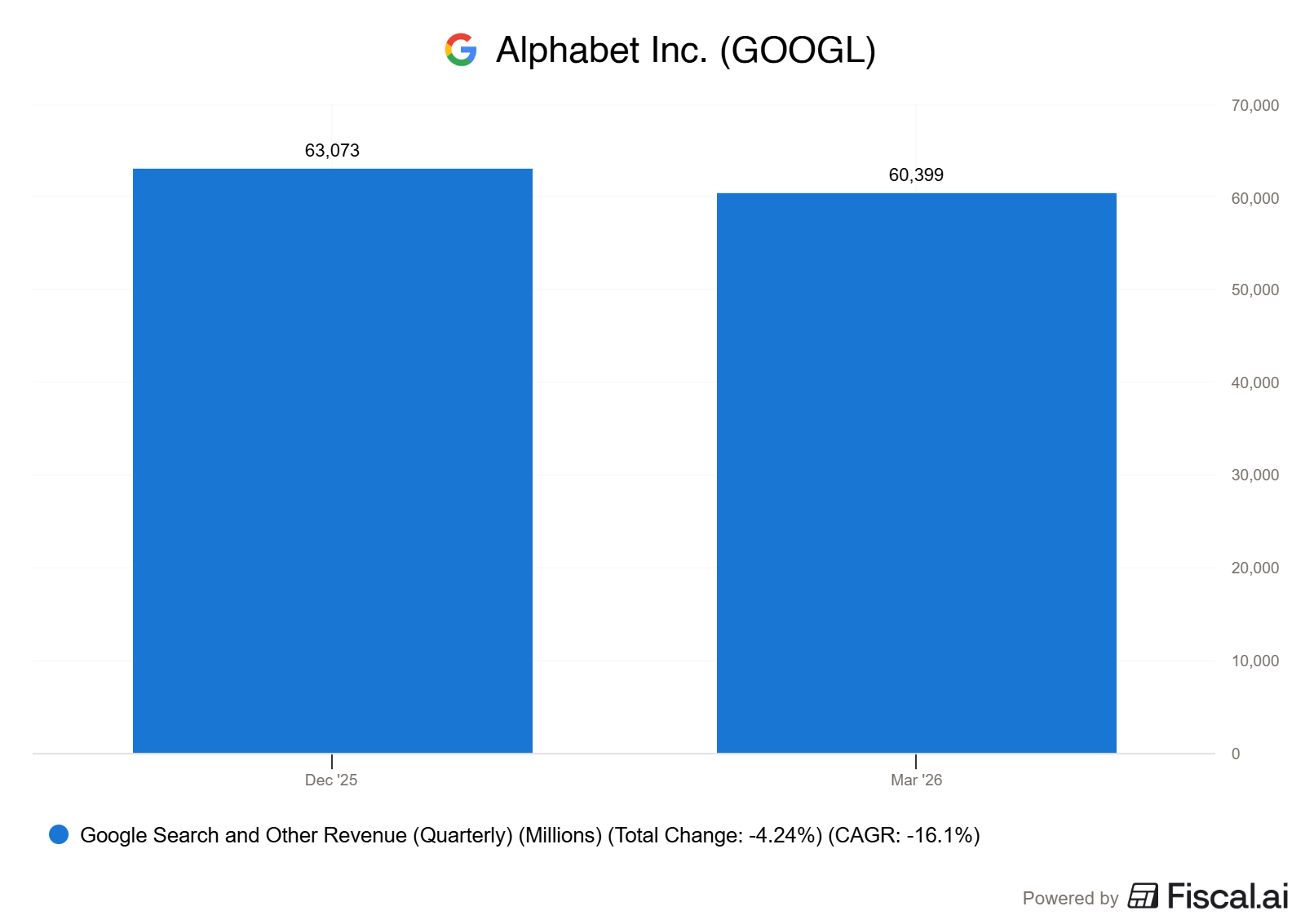
Q1 2026 Search revenue: $60 billion. Growth rate: 19%. Queries: all-time high.
The bear thesis is not just wrong. It is backward. AI is not cannibalizing Search. AI is expanding Search. Here is why.
Traditional Search was optimized for short, simple queries. Three words, ten blue links, done. That model served an enormous number of use cases, but it left a vast category of complex, multi-step, research-intensive queries underserved. People had questions that they knew Google could not really answer, so they went somewhere else, or they gave up, or they broke the question into twelve simpler queries and assembled the answer themselves.
AI Mode and AI Overviews make those complex queries answerable in Search. That means queries that previously left the Search ecosystem, or never entered it at all, are now being asked and answered within Google. Total query volume goes up. Total time in the Search ecosystem goes up. Total advertising inventory goes up.
And the advertising technology sitting on top of this expanding query base is being rebuilt simultaneously. Smart Bidding now uses Gemini to match user intent to advertiser products with a granularity that was previously impossible at scale. AI Max moved out of beta with demonstrated performance improvements. Hilton EMEA captured a third more clicks for a fifth of the spend while increasing average booking value by 55%. Etsy saw a 10% search volume uplift with 15% of those queries being net new to the business.
When the advertising technology generates better results for advertisers, advertisers raise their budgets. When advertisers raise their budgets, Alphabet’s revenue grows. The AI investment is not a threat to the advertising machine. It is rocket fuel for it.
The Strategic Move That Everyone Is Calling a Mistake
Here is the part that most of the hot takes completely missed.
Alphabet is not the only company that is about to need large amounts of public market capitalization. SpaceX is preparing an offering that would imply a public float valuation of approximately $75 billion. OpenAI and Anthropic are widely expected to pursue public market fundraises of enormous scale. The collective capital demand from AI-focused companies seeking public market investment over the next twelve to eighteen months is going to be staggering.
Capital markets are not infinite. There is a finite pool of institutional and retail investment capital available to be allocated to new offerings at any given time. Every dollar that goes into Alphabet today is a dollar that is not available for SpaceX, OpenAI, or Anthropic when they come to market.
Alphabet went first.
They raised $80 billion from a capital pool that is still available, before their competitors can access it, at a moment when their own operating results are so strong that the terms are favorable. They accessed the equity markets before the supply of competing AI investment opportunities expanded. They captured the capital before the competition for it intensified.
This is not desperate. This is preemptive. This is a company that understands the capital markets dynamics of the next eighteen months better than its critics do, acting on that understanding with the decisiveness of an organization that has been planning this for longer than the news cycle knows about.
What Warren Buffett Called the Ideal Business
Buffett spent decades searching for something specific. A business that can earn high returns on invested capital and has the capacity to deploy increasing amounts of capital at those same high returns indefinitely. He called it the compounding machine. He also said it was extraordinarily rare. That most great businesses, even the very best ones, eventually run out of reinvestment opportunities at attractive rates and have to return capital to shareholders because there is nowhere to put it that earns what the core business earns.
Alphabet, for most of its history, was not that business. It was too profitable relative to its reinvestment needs. Search was a cash printing machine that generated far more money than it could usefully reinvest, so it bought back shares and issued dividends. Rational. Correct. But not the compounding machine.
Then AI demand arrived.
And suddenly Alphabet has a business, Google Cloud, that can absorb hundreds of billions of dollars of additional capital at returns that are accelerating. Cloud operating margin expanded from 17.8% to 32.9% in a single year. The backlog is $462 billion. The growth rate is 63%. And the demand is exceeding the supply.
This is the compounding machine. This is the business Buffett described as the ideal. A business where each incremental dollar deployed earns high returns, and where the capacity to deploy incremental dollars at those returns is enormous and growing. These situations are extraordinarily rare. In Buffett’s own words: very, very, very few businesses are like that.
Alphabet is, right now, one of them.
And they know it. Which is why they are raising $80 billion. Which is why they are spending more than their annual operating cash flow on CapEx. Which is why they are telling investors that 2027 will see CapEx significantly increase from 2026’s already elevated levels. They found the compounding machine inside their own business, and they are deploying every available dollar toward it as fast as infrastructure can physically be built.
The Numbers That Exist in 2028
Let me tell you what this business will probably look like in two years, based only on what is already contracted and in motion.
Cloud revenue is $80 billion annualized today. The backlog implies it more than doubles in twenty-four months. Call it $160 to $200 billion in annualized Cloud revenue by 2028. At the current operating margin trajectory of 32.9%, which is still expanding, that implies Cloud operating income somewhere between $52 billion and $66 billion annually. From Cloud alone.
Search is growing at 19% with AI expanding the query base and improving advertiser returns simultaneously. Even at a conservative deceleration to 12 to 15% annual growth, Search revenue reaches $280 to $300 billion annually by 2028.
YouTube subscriptions are growing faster than advertising. The Gemini app is scaling. Google One subscriptions are at 350 million paid subscribers and growing. None of the agentic commerce revenue, the Agent Pay integrations, the Universal Commerce Protocol monetization, the TPU hardware sales, any of that has begun to show up in the numbers in a meaningful way.
The 2028 version of this business, built on the infrastructure being financed by today’s equity raise, is generating operating cash flows that make the current $174 billion look modest.
And the equity dilution from $80 billion in new shares, at a company valued at approximately $2 trillion, represents approximately 4% dilution. Four percent. The question is whether the returns generated by deploying $80 billion into a business with a $462 billion backlog growing at 63% will exceed the cost of 4% dilution. That is not a difficult question to answer honestly.
The Thing I Want You to Actually Feel
Forget the numbers for a second. I want you to feel the scale of what is happening.
We are living through the most significant technological transition since the internet. Every major technology company in the world is racing to build the infrastructure of the AI era simultaneously, spending at a pace that has no precedent in the history of corporate investment. The combined AI infrastructure spending of the major technology companies in 2026 alone will exceed the cost of the entire Apollo program in inflation-adjusted terms, many times over.
Inside that race, one company has a full-stack vertical advantage built over fifteen years that its competitors cannot replicate quickly. That company is being overwhelmed by demand from enterprises that want to pay for what it has built. That company’s contracted future revenue nearly doubled in a single quarter. That company is being told by its own customers, in signed contracts, that they want to spend $462 billion with it.
And that company just raised $80 billion to build the infrastructure to serve all of that demand.
The bears are looking at the equity raise and seeing a red flag. They are seeing dilution. They are seeing a company that needs money. They are seeing a bubble.
What they are actually seeing is a business that identified the biggest commercial opportunity in its history and is deploying capital into it with the conviction of an organization that has seen the signed contracts, read the demand signals, and made the calculation that moving slower would be the costliest mistake it could make.
The $80 billion equity raise is not a warning sign.
It is a company sprinting toward a future it can already see.
Why Stop Here?
eep building your knowledge to beat the hedge funds, money managers, and other institutions in the stock market. I highly recommend the following reads to increase your edge.
Put their money in your pockets!


Before you go.
The investors who compound quietly over decades share one trait.
They protect their edge fiercely.
But they also know when to pass something valuable to someone who’ll use it.
If you know one person who takes investing seriously, forward this to them.
They get free access to everything you’re reading.
You earn points toward Premium every time someone subscribes through your link.
5 referrals unlocks one free month. 15 unlocks three. 30 unlocks six.
Someone is already climbing the leaderboard.
The question is whether you’re ahead of them or not.
→ Check where you stand on the leaderboard here
See you next time!
And remember, great investments don’t shout. They compound quietly.

Note: I would love to hear from you!
If you want to share your thoughts or suggestions about FluentInQuality, or if there are any specific topics you’d like me to cover, just send an email to fluentinquality@gmail.com
Any other questions? Shoot me an email.
Don’t worry! I’ll never share your information.
Disclaimer
By having read this content, you acknowledge and accept the terms of the disclaimer that you can read here.
Great article, really everything i like about it. Just the dilusion is not 4% but just 1,8% as market capitalisation is 4,5 billion, not 2 billion.
Markets have a rule of thumb: profitable companies don’t raise equity. When they do, something is wrong. But rules of thumb fail at the edges. Sometimes raising equity is not a warning sign—it’s the price of speed. The real question is how often investors mistake signals for structure.